|
I went shopping recently, to one of the major retailers, you know the ones I mean. They have elaborate loyalty card schemes and are almost overly enthusiastic in making you feel really welcome – well in the adverts anyway. The brands are all about value for money, quality, choice and the importance of me as a customer.
As I entered the store the strangest thing happened. Before they would let me in I had to tell them my name and address. They also wanted a contact phone number, email address and my agreement that they could send me marketing material about their products and services in the future. I was also required to read their terms and conditions of use as well which were written in legal speak with terms such as 'applicable law' and intellectual property', that I simply couldn't understand and didn't want to read anyway. I was there to carry out a price comparison and would only buy if I felt it was a good deal. Needless to say the shopping experience started badly and from that point it was always going to be difficult to for them to win my loyalty or my business.
If you haven't guessed already this describes my shopping experience at an online retailer, and the frightening thing is it is all true. How busy do you think stores would be if they adopted this approach in the high street? Not very I suspect but organisations seem to consider this intrusion perfectly acceptable on the web. 'The rules are different online' is often stated and is true but not when comparing the customer experience.
The web offers organisations enormous benefits. Unlike high street stores, the Internet allows the retailer to recognise a customer as soon as they return to the store. This means they can also learn about their shopping behaviours, provide them with tools (shopping lists) that engender loyalty and up-sell or cross-sell related products. However the point at which information is captured and the way in which it is used are important. What is acceptable to one user may be totally unacceptable to another. The problem for the online retailer is that they do not know whether they are upsetting customers that are loyal in the online world and simply switching channels, or high potential spend customers.
The chasm between marketing creativity and website implementation can be crossed in a variety of ways. As the web has evolved there has been a significant shift from development focussing on business and IT to a focus between business and the user. As marketing is the custodian of the user or customer they have a vital and increasing role to play in website development. After all, it is just another channel to market.
Enter then usability, or customer experience specialists. 12 months ago the term usability was barely used and poorly understood in the UK. Of the few organisations that claim to practice it many confused usability with market research and all to often information was gathered about what users like rather than what they can use. This distinction between preference and performance is where usability specialists earn their fees.
The development process incorporating usability practices and processes takes the market research about purpose and goals and develops it into user requirements. For example personas are developed to reflect the individual types of people that are likely to interact with the website and then identifies use scenarios that describe the nature of the interaction at every level. From here non-graphical mock-ups, called wireframes are developed to simulate the key practices and processes of the site. These are then tested with users from the target audience, long before any graphics are added. The results are then incorporated into the design and further iterations are tested until a website has been developed that is not only pleasing to the eye of the target users, but that they can also use.
A website developed in this way is more likely to achieve the organisations business goals as described by the following matrix.
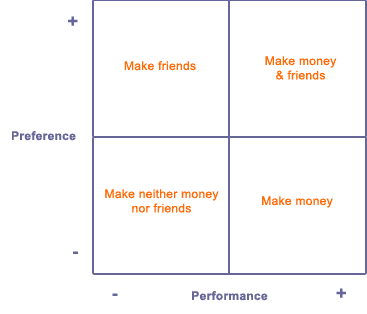
Click here for description of matrix image
Many organisations have found to their cost that sales are lost through their website even though they have a strong brand and excellent market research data supporting their ideas. Outputs of many of the research projects we have run at The Usability Company provide data that show users cannot get through key processes, such as registration or purchase even though in post test questionnaires they score the site high in the preference categories. They are friends of the organisation, but won't spend much money with them. Other sites we have tested have highly usable designs but are lacking in the softer areas. The big difference here is that users like the site because they can achieve their goals, even though they may not have high recognition of the brand.
In order to generate the maximum ROI (return on investment) an organisation needs to combine approaches and make both friends and money. Until marketing people embrace customer experience expertise as they do market research they may well find themselves with many, many friends, but missing out on the revenue available to them.
Recent research we conducted indicated that a high proportion of first time visitors to the site were unable to achieve their goals and were extremely unlikely to return. The online retail market is still in a growth phase and maturity is some way off. Customer numbers continue to grow despite the obstacles they must negotiate to enable them to even enter online stores. What damage is being done to the brand is difficult to quantify but what is quantifiable is just how much money is being left behind.
Return to newsletter
Figure:
High preference and high performance equates to making money and friends
High preference and low performance equates to making friends only
Low preference and high performance equates to making money only
Low preference and low performance equates to neither making money nor friends
|