USEworthy October 2003
The monthly Newsletter from The Usability Company
Welcome to October’s edition of USEworthy. In this issue, we bring you highlights from our interview with Andrew Pinder, the UK Government’s e-Envoy at this year’s British HCI conference. This is the first in our series of highlights from interviews held at the British HCI conference. In the following months, we shall present excerpts from our interviews with Bob Reegan, who spearheads accessibility at Macromedia and Gordon Smillie, Group Director of Microsoft Enterprise in which he shares Microsoft’s stance on usability and the internal processes Microsoft has put in place to ensure that usability considerations are at the heart of Microsoft product development.
In addition, we present a case study illustrating the User Centered Design work The Usability Company completed for Camelot on The National Lottery website. The Case study demonstrates how User Centered Design plays an integral role in developing the most appropriate processes and structure for websites to fit specific business and user needs. The User Centered Design work completed for Camelot required a review of subscription and registration processes, customers' personal account management features and the online gaming process in order to determine the best options for processes and structure. Usability Evaluations were also conducted at key stages in order to test the User Centered Design's recommendations with real users and to inform the User Centered Design and Camelot team in choosing the most appropriate solutions.
We also present an article by Brent Heiggelke, Vice President of Marketing for WebTrends Web Analytics at NetIQ, in which he offers tips on how marketers can dramatically improve marketing success by maximising the opportunities available to marketers through the ability to capture exact information online.
The Usability Company News
September was a busy month at The Usability Company with members of the company taking part in some exciting and worthwhile speaking engagements. Catriona Campbell, Chairman of The Usability Company chaired the Industry Day of this year’s British HCI conference in Bath. Keynote speakers included Andrew Pinder, the e-Envoy from the Office of the e-Envoy, Gordon Smillie, Group Director of Microsoft Enterprise customers across all verticals, partners and consultancies, Bob Regan, Senior Product Manager for Accessibility at Macromedia and Hiroshi Ishii, tenured Associate Professor of Media Arts and Sciences at the MIT Media Lab.
The Usability Company is delighted to announce that we have received the trademark registration certificate for Usability Analytics®. Through our Usability Analytics® service, our Usability Specialists take website visitor data, interpret it from a usability perspective, and deliver actionable knowledge to rectify issues impacting usability. We have partnered with leading web analytics providers including Net IQ, provider of the leading web analytics solution, WebTrends to ensure that we have in-depth knowledge of the various web analytics tools available. Marty Carroll, Director of Usability Practice at The Usability Company wrote a widely acclaimed and published white paper on Usability and Web Analytics. In the white paper, Marty discusses the key issues and benefits of combining usability and web analytics tools and explains how ROI can be measured and analysed using methods that allow marketing and e-commerce managers to justify, plan and strategise investment in online channels realistically and effectively. For a free copy of the white paper, please go to the resources section of our website by clicking through the following link https://theusabilitycompany.com/cgi-bin/research_feedback.cgi?ref=research and download the “Usability and Web Analytics: ROI justification for an Internet strategy” white paper.
And Finally...
The Usability Company will hold a workshop for government managers in November 2003. We have been gathering feedback from government managers on the specific areas of usability that they wish to investigate in preparation for the workshop that will address these issues and those surrounding the implementation of the key advice given in The Quality Framework for UK Government Website Design, which was launched this July by the Office of the e-Envoy. Catriona Campbell, Chairman of The Usability Company was one of a panel of experts from voluntary, Industry and government sectors and academia that advised on quality issues for the document. Please contact Funmi Tomisin on or email for more information on the upcoming workshop and to reserve your place.
We have been receiving encouraging feedback from attendees of our accessibility training course. Please click through the following link for more information on the course and comments from clients who have taken the one-day course .
Take a Chance and Grab the Reward
By seizing the online opportunity, companies can create exciting new marketing possibilities
Brent Heiggelke, VP of Marketing for WebTrends Web Analytics, NetIQ.
Many marketers have experimented with using the 4 Ps – product, price, place and promotion – on the Web. But few are really maximizing the experience and using it to its full advantage. Some don’t even agree that the 4 Ps can be fully transferred to an Internet environment. Most like to play it safe and simply create an online version of their offline catalogue and perhaps dabble in a bit of e-mail marketing.
However, the Web can be used as an effective tool that can both increase the scope and creativity of marketing efforts and reduce the financial risk involved. On the Internet, marketers can employ trial and error as a means of effectively determining the best possible approach to market, without the costs involved with a physical launch or making in-store campaign changes. This is compared to the offline environment, where making an error on product positioning, pricing, store location and promotional approach can quickly become a costly mistake. In a sense, your home page can become your virtual ‘test lab’, where visitors vote with their clicks, letting you know precisely what’s hot and what’s not, before you commit to expensive offline changes.
For a marketing department with a restrained budget, tweaking prices online, rather than rolling out incremental price changes across a network of stores, is certainly a more cost effective solution. Proctor and Gamble1 uses the Web to preview many of its new products and offerings to the market. By precisely determining customer interest and demand, it can streamline its product rollout by optimizing the level of stock it feeds into the supply chain and ensuring the best possible pricing.
Those companies willing to fully embrace the Internet as a more effective and flexible marketing medium can raise the game to an even higher level. Take easyJet2, which sells its low-cost flights through its Website and its call center. It constantly tracks customer interest in its flights and makes continual incremental pricing alterations accordingly. As soon as the 18h30 flight on Friday night starts generating more interest, the price immediately starts climbing. And rather than chasing customers away, the constant price changes act as an incentive to its customers to return again and again to seek the best possible deal.
However, along with the flexibility and cost-cutting potential it delivers, the Web also brings with it a few unique challenges. The first is to ensure that your customers’ expectations are met – and exceeded – when they visit your site. The second is learning to operate within radically reduced timescales.
Practically all sites fit into one of four business models: online selling (Amazon); online lead generation, offline selling (BMW); online self-service or information (local Government); and ad-driven content sites (Fortune.com). What all these sites have in common is that they have determined what motivation their customers have for visiting their site and then ensured that those expectations are met. By carefully tracking online movements and actions, marketers can meet expectations and ensure that their site remains in touch with their customers.
The reduced window of time available for companies to react to market changes means Marketers today need to rapidly analyze information, make decisions and then convert them into action. Those who don’t act quickly enough to the constant shift in customer desires and demands will lose out to the competition that can.
By learning to exploit the Web’s ability to provide exact information for analysis, you can dramatically improve your marketing success.
Brent Heiggelke is Vice President of Marketing for WebTrends Web Analytics at NetIQ. Download his ‘Winning on the Web’, a free executive pocket guide to smarter marketing, from www.webtrends.com, to learn more about achieving Internet-based marketing success.
Case study: National Lottery/Camelot
Site www.national-lottery.co.uk
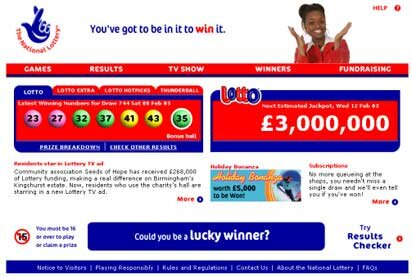
Camelot is the operator of the UK National Lottery. Camelot's main objective is to maximise revenue for Good Causes and the Government through lottery games in the most efficient and socially responsible way. This involves creating, marketing and promoting new games, running and developing the lottery infrastructure, providing services for players and winners and working in partnership with retailers.
At present, players can play the lottery via a retailer or by subscription. Camelot plans to offer National Lottery games on the Internet, mobile phones and Interactive TV.
Development overview
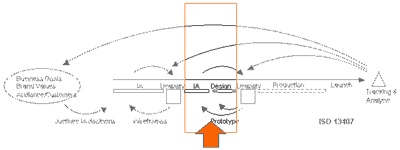
The following diagram illustrates the areas of activity of the project.
Challenge
Camelot was very clear about its business goals and strategy regarding its plans for on-line gaming. The User Centered Design was appointed to develop the on-line gaming experience, which was structured as follows:
- Review of games section
- Registration process
- Account management
- Subscription process
- On-line gaming process
Solution
Review of games section
The current structure of the web site already had a section called 'Games' and users understood this section as a pure information source. The dilemma was to promote the new services without confusing the existing audience and it was decided to merge the two sections because having two sections called 'Games' and 'Games on-line' was considered too confusing for the audience. A sitemap that showed the best way to merge the two sections was developed and passed on to web designers for implementation.
Registration process
On-line gaming requires the user to register and open an account with Camelot. Furthermore each user had to deposit a minimum amount of £5 unless one or more lottery tickets worth that amount were purchased in one session. It was therefore important, when creating the wire frame, to concentrate on a user-friendly registration process that explains the steps involved clearly and guides the user on how to deposit money.
Account management
Camelot customers are able to manage their accounts online. Customers can edit their account and profile, add combinations of numbers to their favourites and either deposit or withdraw money to or from their wallet. A set of wireframes was used to define these processes and identify the technical requirements.
Subscription process
Camelot plans to give customers the option of subscribing online. The User Centered Design's task was to develop the subscription process online through in-depth consultation with the client, which included workshops to fully understand the current processing of subscriptions and the implications of the proposed online subscription process. Wire frames were then produced to investigate the best solution for selecting the numbers. These wire frames were used for user testing.
On-line gaming process
After the structure of the games section was specified, wire frames were used to define the processes of playing the lottery online. The wire frames demonstrated how and when users need to register and/or sign in to successfully purchase a lottery ticket on-line.
Some user testing was conducted on the subscription pages, which revealed a great deal about how users prefer to perform certain tasks online including how users prefer to pick their numbers.
The gaming process was formulated from PowerPoint and converted into HyperText Markup Language (html) pages. Actual HTML is best for user testing as the pages are in a browser environment and contain screen elements that are both realistic and semi functional - which is half way along the road to prototypes.
Results
- The structure of the games section was reviewed and recommendations were delivered regarding the integration of new products.
- The processes for purchasing a lottery ticket on-line were defined and wireframes were handed over to designers and back-end developers.
- In addition, requirements for the registration process and account management tasks were defined and documented.
- The on-line subscription process was developed with back-end developers to ensure smooth transition from print to on-line submission.
Highlights of The Usability Company Interview with the e-Envoy, Andrew Pinder.
The Government and Usability
- Question: Why is usability important with respect to government services?
Usability is important irrespective of (whether) people use government services. I think it is very important particularly when you think about the audience the government has, which is everyone in the UK and every business in the UK. There is a wide range of businesses and a wide range of people and therefore you have to try to make government information and transactions available in a very usable way to all sorts of different people, at different levels of skills with different levels of knowledge and different abilities. Therefore, it is of particular importance for us, compared to say an organisation just selling to a particular narrow group of people. They can define their audience much more precisely and target usability just at them, so it is crucial and essential to what we do.
Accessibility
- Question: You spoke about accessibility during your speech and how important it is for government websites. Some while ago there was a report, which claimed that 75% of Government websites were not accessible. Are the government websites aware they are not accessible and also what are they planning to do about it in the next couple of years to make themselves more accessible?
There are a number of government websites that are used extremely heavily, e.g. the Number 10 website is obviously used a lot, particularly by journalists, the Inland Revenue site, the National Health Service, and NHS Direct site all dominate government internet access. They're all very good sites and they get awards for accessibility. There are a few sites that should be more accessible and aren't and we'll try to focus on those...
Sites should be aware of their accessibility. We recommend that people do test their sites for accessibility and we suggested how they might do that in our latest document that was introduced in July, which is about accessibility on government websites, (and is) recommended to webmasters on how they should check whether their sites are usable or not and we expect them to follow the recommendations. **
- Question: Who should be setting the accessibility standards?
I think the people who know a lot about accessibility are the experts. That's what the conference today was about.
Any large organisation would be daft not to listen to an accessibility expert when they are devising their websites so that they can appeal to their customers. I'd appeal to anyone that's building a website to make sure they get good advise about accessibility issues exactly the same way as they would get technical advise on IT issues to do with the design. Secondly, the government has a particular responsibility in dealing with issues such as social inclusionto firstly set it's own house in order by making sure that its information provisions are accessible to people. Hopefully that example will also help other people decide that that's what they want to do as well.
If you are suggesting we go further than that and legislate for the standards of all websites. It is a totally impractical thing to do as, a lot of the websites people look at in the UK are based outside the UK, and my only inclination I would have to say is, that the government should set an example by doing it for themselves. Where it can make a difference in propagating international standards of accessibility we should try to do that but we can't make people who are putting information on the web do things they don't necessarily want to do. Mainly because it is unenforceable and secondly, if it is a commercial organisation that is trying to sell something, their markets will tell them if it is accessible or not and as a result will simply fail.
Funding for government websites
- Question: Many local government site managers claim that they do not have enough budget to make their sites usable and accessible. How can these government sites make their sites accessible?
I think web access offers a real opportunity for Local Authorities, just as it does for Central Government, to improve the delivery of their services to their voters. I think it is also an opportunity for them to make sure (that) they can make themselves efficient organisations. In some respect the web can help them minimise their costs.
So I personally feel that a local council just like central government needs to think really hard about the real benefits they will receive if they tackle web access properly, both in terms of providing a better service to people and also providing a cheaper service to people. They should allocate their resources accordingly.
There are times when it would make no sense to pile a lot of money into a particular service when actually it can be more effectively and more efficiently done through a call centre or through face-to-face contact. There is a range of areas where that is not the case and where web access reduces the work loads of hard-pressed staff in local call centres or staff dealing with people face to face, subsequently relieving them and resulting in money well spent. The individual councils have to decide what is important for them at a local level.
You will see over the next year or so, firstly the number of sites diminishing as we try to weed out sites that don't need to be there. Secondly, the sites that are here will become much more usable and better focused on their customers and their audience and will be accessible to everyone that needs to have access to them.
Reflections on the role of e-Envoy
- Question: You have held the position of e-Envoy for three years now. Now that you are coming to the end of your term as the e-Envoy, what legacy would you like to leave behind?
There is a large amount of people involved here not just in my office. I shall look back with some pride, not just on my behalf but also on behalf of all the other people who have been working with us. The fact that we have made a huge amount of progress on allowing physical access to the internet, we have gone from no UK Online Centres to 8,000 net. Every library has Internet access. 99% of schools now have internet access. On the physical access side, we have done an enormous job.
Secondly we have done a tremendous job in helping people use the internet. Internet access by the majority of the population is now a given. Most people now regularly use the internet and it is now entered into the language people use. We have done quite a lot compared to other countries and are working hard to make the UK a leading nation.
One of the big issues around the time I arrived was 'Broadband' and an awful lot has been done not just by the government but also by particular telecommunications companies, particularly British Telecom and their new Chief Executive, Ben Verwaayen. Ben came into the job 20 months ago saying he was going to make Broadband something he lived or died by. He said if he jumped off a cliff shouting Broadband, his only hope was that the rest of the company followed him. I think we are part of the influence that made them emphasise that so much and I'm very proud of that.
I think we also made huge strides on the government side. We really got the debate going on how we get people to use government websites, three years ago we didn't have people talking about how we use these things and now we do. We now recognise that it is just as important to make them usable as it is to make them available, and that is important around the customer focus area and in particular it is about making the sites themselves look good, be usable by anybody that should be using them, be readable and understandable by them and be easily followed and easily found, and I think we have made massive strides. There's still along way to go but we wouldn't be having the similar debates were having now, two years ago and I'm very pleased about it.
** You will find a copy of the quality framework document at the Office of the e-Envoy website. Please scroll down on the page for the document titled Quality Framework for UK government website design.
Click here to print
Back to The Usability Company website
If you wish to republish some of The Usability Company's material on another website, you must include the following sentence:
This article is reproduced from The Usability Company website - used with permission. © Copyright The Usability Company 2003
Ensure that you place a link to https://theusabilitycompany.com as shown.
|